Artworks · 2026
Authonomy: Fluid Geometry
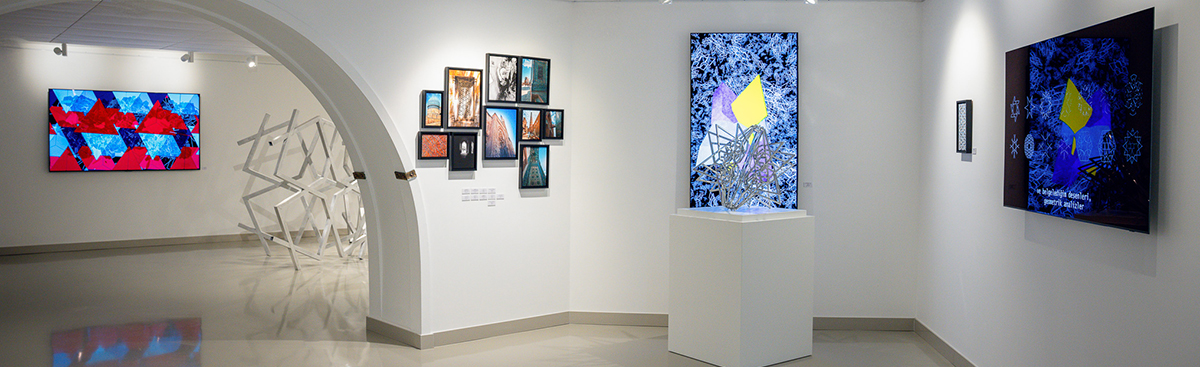
Exhibition: Terakki Sanat 25.03.2026-24.04.2026
Throughout the history of art, geometry has established an unshakable order on architectural surfaces. This mathematical legacy, imprinted on durable surfaces such as stone and ceramic, is now being taken to a new dimension through digital systems. This convergence gives rise to hybrid spaces that bridge the ancient knowledge of the past with the algorithmic possibilities of the future, transforming the static into the dynamic. Ultimately, form takes on a fluid structure that offers a mental intensity. In his exhibition “Autonomy: Fluid Geometry,” Selçuk Artut places us right at the center of this abstract intensity—a dynamic space where form transforms into a living, breathing organism. The cosmic order of the Great Seljuk Empire, the mathematical depth of Anatolian Seljuk architecture on stone, and the ancient energy sealed within the mystery of the tile come to life through Artut’s algorithmic touch. As the artist filters historical memory through a contemporary lens, she succeeds in dissolving the rigid structure of stone and earth into the fluid nature of code. Rather than imitating the forms of the past, the artist liberates their spirit through digital alchemy, integrating the accumulated tradition of geometric art into today’s production practices. By distributing his absolute authority over the creative process into the code itself, he follows a method that establishes the rules yet leaves the final outcome to the rhythm of probabilities, randomness, and the machine’s autonomous decisions. The unshakable absoluteness of traditional geometry gives way to a new aesthetic freedom where code sequences speak their own language. “Interwoven Confluences” (2025), which forms the backbone of the exhibition and debuted on the world stage at EXPO 2025 Osaka, is the clearest reflection of the concept of fluidity. In this video, which brings together two distinct yet harmoniously intertwined geometric traditions, we witness the seamless interweaving of Japan’s Asanoha pattern with the Seljuk star motifs of Turkey’s cultural heritage. Far beyond a three-minute video piece, the work—which moves like an autonomous dancer driven by mathematical data—constructs a universe where initiative is shared with the algorithm. Meanwhile, we bear witness once again to how geometry transcends geography to converge with the spirit and mathematical elegance. The two sculptures that form the physical backbone of the space clarify the need for the code to produce a spatial counterpart. Through the combination of large-scale sculpture and Moving Image + Sculpture, Artut contrasts the digital flow with the resistance of mass. The screen and the object stand before us as two distinct outcomes of the same system of thought. The sculpture does not position itself as an element that fixes form; rather, it exists as an extension of the code, the face of the flow that leaves a trace in space. The dialogue between moving images and sculpture, along with the 3D compositions, offer bold propositions regarding how digital data can take physical form in a space… The 12 photographs in the selection, meanwhile, capture frozen moments of the technological flow, documenting the aesthetic memory of the process; the informative video invites us into the artist’s mental kitchen, into the production process where code and philosophy intertwine. The radical break signaled in 1971 by Frieder Nake—a pioneer of computer art and mathematician—is revived through Selçuk Artut’s practice. According to Nake, the computer artist no longer produces a singular object but rather designs the set of rules that bring the object into being—that is, the process. The program is not a finished artwork but the definition of a class of objects. (Nake, 1971, p. 12) In Artut’s world, too, the object transcends a frozen moment to become an “event.” Rather than carving an object, the artist places an autonomous process—one that subverts the traditional concept of the object by encoding the possibilities of becoming—within the gallery space. As Nake argues, by defining a class of objects rather than a single object, the artist writes the genetic code for the thousands of possibilities that form can take. Here, autonomy is the system itself that determines how lines will move. Selçuk Artut’s geometry gains an autonomous existence within time and the algorithm. “Autonomy: Fluid Geometry” is a call to bear witness to the hidden poetry of mathematics and the infinite transformation of form. The works are less a linear bridge between past and future than a manifesto of a new aesthetic language where geometry, autonomy, and fluidity intersect; the forms themselves become a living process that is constantly changing, redefined at every moment, and blended with the spirit of the machine. Thus, rather than disrupting geometry’s absolute silence with digital noise, Artut compels us toward a new way of seeing through the elegance of autonomous intelligence.
Nake, Frieder (1971). “The Object and the Process”. Computer Graphics, Vol. 5, No. 2
text by Nazlı Pektaş
Link to the catalog


